Barometer
What is a barometer?
A barometer is an instrument that measures air pressure, the weight of the atmosphere above you. Pressure changes as weather systems pass, so a barometer is also a simple forecasting tool: falling pressure usually means clouds and rain, rising pressure means clearing.
Live · KCMH · reported 26 min ago
Online barometer
Nearest station to Columbus, OH
29.93inHg
1013.6 hPa (mb)
- 3-hour change
- −0.07 inHg · −2.4 hPa
- 24-hour range
- 29.93 – 30.15 inHg
- Station (absolute) pressure
- 29.11 inHg
- Barometer dial reads
- Change · near normal
What it measures
What does a barometer measure?
It measures atmospheric pressure. At sea level the air presses down with about 14.7 pounds on every square inch, which a barometer shows as 29.92 inHg or 1013.25 hPa. Most days stay within about 1 inHg of that, and those small moves are the weather signal.
What air pressure is · What barometric pressure means · Convert the units
Types
The four main kinds of barometer
All of them balance the weight of the air against something that can be measured.
A glass tube of mercury stands upside down in a dish. Air pressure holds the column up, about 30 inches at sea level.
Used in: Laboratories and antiques
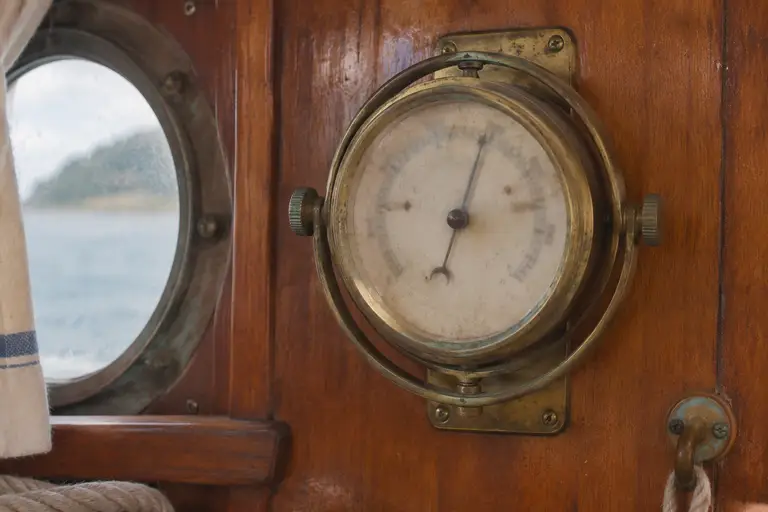
1844 Aneroid barometerA sealed metal capsule flexes as pressure changes, and levers turn that movement into a needle on a dial. No liquid.
Used in: Homes, boats and aircraft
1980s on Digital barometerA tiny silicon membrane bends under pressure and a chip reads the change electrically.
Used in: Phones, watches and weather stations
1800s BarographAn aneroid barometer with a pen that draws pressure on a slowly turning paper drum.
Used in: Ships and weather offices
How to read a barometer
Note the number, then watch which way it moves. On a dial barometer, turn the knob on the glass to line the brass set hand up with the needle, and check back a few hours later. If the needle has moved right of the set hand, pressure is rising; if left, it is falling. The words on the dial, from Stormy to Very Dry, are only rough labels. The full guide
Why the reading depends on where you are
A barometer reads less the higher it is, about 1 inHg for every 1,000 ft. Weather reports correct for that and quote pressure at sea level, so a dial barometer should be set to match the local report. That correction is why a phone in Denver may show 24.7 inHg while the forecast says 30.0.
Who uses barometers today
- Weather services: thousands of stations feed pressure into forecast models. The airport stations behind this site are among them.
- Pilots: an aircraft altimeter is a barometer set to the local pressure.
- Sailors and anglers: a falling barometer is an early storm warning, and many anglers fish by it.
- Phones: the built-in sensor counts floors and improves altitude. Which phones have one
Frequently asked questions
What is a barometer?
A barometer is an instrument that measures air pressure, the weight of the atmosphere pressing down on a place. Because pressure changes as weather systems move, a barometer also helps forecast the weather.
What does a barometer measure?
Atmospheric pressure, usually shown in inches of mercury (inHg) in the US and hectopascals (hPa) or millibars (mb) elsewhere. Standard pressure at sea level is 29.92 inHg, or 1013.25 hPa.
What is a barometer used for?
Mostly for short-range weather forecasting: falling pressure points to clouds, wind and rain, and rising pressure to clearing. Pilots, sailors, anglers and hikers also use barometers, and an altimeter is a barometer scaled to show height.
How does a barometer predict the weather?
It shows which way pressure is moving. A steady fall usually means a low-pressure system or front is coming; a fall of more than about 0.10 inHg (3.5 hPa) in three hours means wind and rain are close. How to read a barometer.
What is a good reading on a barometer?
There is no good or bad number. About 29.80–30.20 inHg (1009–1023 hPa) is normal, higher usually means fair weather and lower usually means unsettled weather. What counts as normal.
Who invented the barometer?
Evangelista Torricelli, an Italian physicist, made the first mercury barometer in 1643. Lucien Vidie patented the liquid-free aneroid barometer in 1844.
Does my phone have a barometer?
Every iPhone since the iPhone 6 does, and so do many Android phones. It reads the pressure where you are, so it shows less than the sea-level number in the forecast.
What is the difference between a barometer and an altimeter?
Both measure air pressure. A barometer shows it as pressure, and an altimeter converts it to height, because pressure falls as you climb. See What is my altitude?